Gabo Legwala
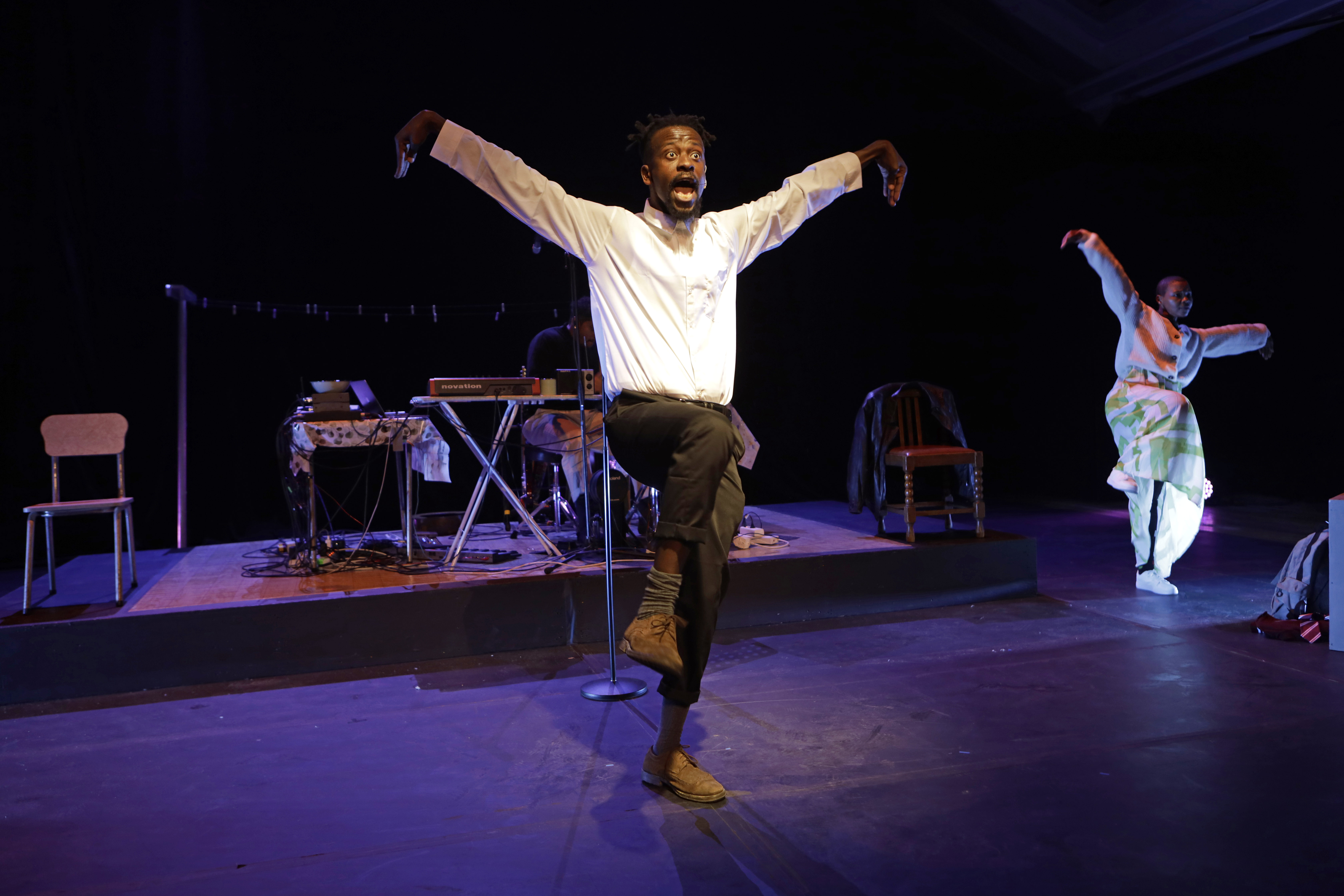
Set in Devland, Soweto, the work follows a group of boys – fatherless, restless and ever- stumbling. Through music, poetry, and storytelling, we journey with the young Modise and his childhood friends as they stumble toward manhood without the map of a father’s example. At its core, this is a meditation on what it means to be a man when manhood is inherited in fragments – from soccer fields, kung fu movies, playground fights, bullying and boyish bravado.
- Rating: 4.92 / 5 (12 reviews)
Reviews
- Zandile Sibanda — ★★★★★ (5/5) — October 14, 2025
Gabo Legwala delivers a raw, poetic, and beautifully composed meditation on what it means to grow up as a man without a father’s shadow to measure yourself against. Set in Soweto and carried by the heartbeat of music made from everyday objects — cups, spoons, bottles, and tins — the production transforms personal memory into communal rhythm. The play unfolds as a series of lyrical recollections, each layered with song, silence, and sound. Modise and the ensemble move effortlessly between storytelling and performance art, crafting a sonic landscape that mirrors the improvised rhythm of township life. Each clang, hum, and tap becomes a pulse of memory — echoing the sounds of kitchens, yards, and playgrounds where boys learned to be men through imitation and pain. Modise recalls being the last born and only boy among three sisters — raised by four women, his mother and sisters, each offering love that was both nurturing and protective. His father, already in his sixties when he was born, passed away before he could form a memory of him. “People thought my mother was my grandmother,” he says, a line delivered with both humour and melancholy. His story of childhood mornings — warm porridge preparing him for the darkness outside, — evokes a vivid image of love performed through care, ritual, and survival. But beneath this warmth lies the ache of identity — the struggle to understand what being a man means when all your teachers are women. One of the play’s most striking and symbolic moments comes when he recalls his circumcision. As a child, his mother once pricked him with a diaper pin by mistake — a wound that became almost mythical in his mind. Years later, during circumcision, the doctor’s needle pierces him again in the same place, triggering the memory. The audience laughs in discomfort, but the silence that follows is weighted and necessary. He reflects, “Maybe my mother forgot I was a boy — she had been raising girls her whole life. But no one tells tales of a man’s wounds.” That single line — “no one tells tales of a man’s wounds” — becomes the spiritual core of the play. It speaks not only to physical pain but to generational silence, to the way men are taught to hide their suffering and swallow softness. Through his friendships, the play expands into a collective portrait of boyhood in Soweto. He speaks of his three childhood friends, each defined by their father’s presence or absence. The one friend whose father was alive and present, became their model of masculinity — fearless, protective, unafraid to fight. Another friend had a father who disappeared into prison. His family told him that his father was “behind the mountain.” So the boy would climb hills, searching for the mountain that hid his father, believing that if he could just reach the peak, he might see him beyond the horizon. This story is delivered with haunting simplicity, and as Chinese music plays softly in the background — a nod to the kung fu era where the boys taught themselves manhood through films — the symbolism deepens. The mountain becomes not just a physical distance but a spiritual one: the unreachable image of the father, the myth of what it means to be a man. Modise and his friends, all fatherless in different ways, try to teach themselves how to fight — studying karate movies, mimicking Bruce Lee, rehearsing toughness. “But we didn’t even know how to form a fist,” he admits. That confession is both tender and tragic. The sound of spoons striking bottles becomes a percussive heartbeat beneath his words — the sound of boys trying to find rhythm in a world of uncertainty. Later, he recalls the humiliation of being beaten and having his mother fight his battles for him. “I was known as the boy who ran to his mother,” he says, half-smiling, half-ashamed. But through that shame emerges another kind of strength — the strength of softness, of endurance, of learning to walk away. His journey toward manhood becomes less about fighting and more about feeling. Through poetry and rap battles, he learns to “throw fists with words,” to turn pain into rhythm. The ensemble supports these transitions with voice and movement, turning every beat into a dialogue between body and memory. As the play nears its end,Modise reflects on what he has inherited — not from his absent father, but from his mother. A simple handkerchief becomes his sacred object. It has wiped sweat, tears, and perhaps prayers. “It’s like my mother gave me a piece of her strength,” he says, holding it as though it were a relic. The production’s minimalism gives space for every sound, gesture, and silence to breathe. The lighting shifts softly between gold and blue — warmth and shadow — marking the fluid movement between childhood innocence and adult reflection. In its final moments, the play leaves the audience with haunting questions: “What wounds do men carry who are raised without fathers? What does healing look like when they have never seen it modelled? When is walking away cowardice — and when is it wisdom?” “ Gabo Legwala” is not merely a theatre production — it is an act of healing. Through language, rhythm, and memory, it creates space for men’s pain to be spoken, witnessed, and honoured. Modise and his ensemble deliver a performance that is deeply human — tender, humorous, spiritual, and profoundly resonant. It is a play about sound and silence, about the softness men inherit from the women who raise them, and the courage it takes to admit that love — not violence — might be the truest mark of manhood - Tankiso Mamabolo — ★★★★★ (5/5) — October 8, 2025
This was my favourite play of 2025. My favourite thing about Gabo Legwala is that this man is grappling with himself, his childhood and his trauma in ways that make the stories relatable and accessible. One of the greatest lies is that men and women are too different and therefore cannot understand or empathise with each other’s realities. This play debunked that myth over and over again. It provided no answers, no magical conclusions and no remedies to the gendered violence we experience as a country but it did give me hope to see thoughts such as these put on stage. We all know loss, insecurity and pain. The music was like a warm blanket after a long day and the skill was simply too much to witness only once. Well done to the team. I wish everyone, especially men would see this and understand that being in pain is ok but you need to speak about it and release yourselves from this stoic, toxic existence that has been forced onto you. Patriarchy hurts us ALL and we ALL need to humanise each other and dismantle It. We were all children once and we had hopes and dreams and innocence before our realities turned us into fighters. I cried, I laughed, my inner child empathised with his inner child and I left with a deep sense of gratitude that we were given a glimpse into a story so deeply personal. Go watch this play Now!! - Sbo Cossa — ★★★★☆ (4/5) — October 4, 2025
Every man should see this play. What an incredible tale of vulnerability and the process of becoming as a man. It was unexpectedly funny and sentimental in all the right places. Stellar work to the entire cast - MoMo Matsunyane — ★★★★★ (5/5) — October 4, 2025
What a treat this show was! The personal stories shared made us feel like we know all those people. The familiarity of the pain was deeply moving. The beautiful hybrid of dramatised poetry, music and scoring makes this show stand out. I’ll definitely be seeing it at least two more times before the run ends. I’d like to think of the directing as gentle and perfectly seamed together to tell the story of Legwala. I absolutely loved it! Well done to the whole team. I hope the show travels locally and internationally. - Sinethemba Dywili — ★★★★★ (5/5) — October 2, 2025
Aah man, I have no words to describe what I witnessed in there. It was beautiful. The poetry, the music. Thank you to the cast for beautiful storytelling. I'll be coming again tomorrow. Sinethemba Dywili - Kamogelo Molope — ★★★★★ (5/5) — September 22, 2025
It's one thing to be in remarkable spaces. It's another leaving with its mark, and once again Theatre Duo did it. It's an absolute honour to pay witness to a true work of art. Talent all through! I was serenaded by the poetry, the creation of the music, the set. Everything fell into place, and you could tell the sweat that was put into this. We appreciate the story for sharing experiences one would never imagine going through or being of a certain cause. It was all like a flash in my eyes but of someone else's lens. One moment got me reminiscing about the white porridge my gran used to make for us and all the letters, poems and journal entries she found that I used to write, and all of a sudden, life has a purpose again. - Sarona Sullaphen — ★★★★★ (5/5) — September 22, 2025
Brilliant. The combination of music and poetry, evoked all kinds of emotions as we were on this journey with the main character. Solid message about today's men. - Ntsikelelo Dzedze — ★★★★★ (5/5) — September 22, 2025
Stunning, Stunning. What a gift of story that provokes the the brokenness of current masculinity through poetry. I've never experienced poetry in story like this. Thank you What a treat. I can't wait to go see it again. - Tshepo Nxasana — ★★★★★ (5/5) — September 21, 2025
I don't have many words to express how amazing this show was from start to finish. I'm a movie fanatic and this felt like a cinematic experience in real life. It was deep, it was emotional, it was RAW. The timing, the pacing, THE ENDING... It wasn't too short, it wasn't too long, it was just right. The music from Yogin Sullaphen and the vocal performance of Phumla Siyobi was incredible, and Modise Sekgothe's performance was an easy standout. All three of these performers just worked with each other so well and told this story in a way I've never seen before. Modise Sekgothe's Gabo Legwala is the closest thing we have to experiencing heaven on earth. An EASY 5 STARS. - Trevor Lynch — ★★★★★ (5/5) — September 20, 2025
Something about the authentic storytelling of boyhood, manhood, growing up without a father, not being taught how to fight yet fighting with courage, bravery and the biggest heart. Modise Sekgothe, thrills us with exactly that. Craftsmanship from the heart. [I am 11, 13 and 17 years old. And at age 26 I sobbed the tears my 11, 13 and 17 year old self hadn't in a theatre full of people watching a show called Gabo Legwala] Do the right thing. On at the Market Theatre til October 12. - Yana Fay Dzedze — ★★★★★ (5/5) — September 20, 2025
This level of convergence between music, theatre performance, and poetry was so refreshing. A brave memoir. Personal stories, wrapped into a fearless telling of boyhood, manhood, masculinity, fatherlessness. Thank you Modise, for you courage to press into the places most shy away from. Thank you Phumla for your oozing whole-hearted song. Thank you Yogin for your multi-instrumental genius. Thank you Theatre Duo & Co, for giving us an opportunity to stand for ovation. May more eyes see this work, more ears hear this work, and more hearts hold it. Hurrah! - Itumeleng Manaka — ★★★★★ (5/5) — September 19, 2025
Beautiful collaboration of artists and storytelling. I hope they tour this and continue to share this form of storytelling.